
Sustainable House Cleaning: How Services Can Reduce Waste

The way we clean our homes is changing. More people are asking not just for spotless kitchens and fresh-smelling living rooms, but also for cleaning services that protect the planet. Traditional cleaning often relies on disposable products and harsh chemicals that create undeserved waste. But residential cleaning experts are finding more innovative, greener methods. By focusing on sustainable practices, they can reduce waste, cut costs, and provide healthier homes.

Why Cleaning Creates So Much Waste

Most waste in house cleaning comes from two sources: disposable products and packaging. Think of the endless paper towels, single-use mop pads, plastic bottles, and throwaway gloves. Many of these items end up in landfills after only one use. On top of that, chemical-heavy products require plastic packaging and sometimes come in small, non-refillable containers.

The other problem is overuse. Many cleaning routines call for far more detergent, disinfectant, or water than necessary. This doesn’t just waste resources; it increases pollution when harsh cleaners are washed down drains. The result is a cycle of waste that affects both households and the environment.

The Shift to Reusable Supplies

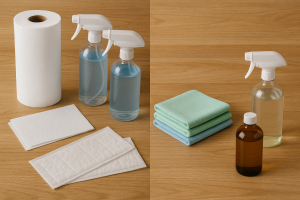
One of the easiest ways cleaning services can reduce waste is by switching to reusable tools. Instead of paper towels, microfiber cloths can be washed and reused hundreds of times. Mop heads can be laundered as well, cutting down on single-use pads. Even cleaning gloves now come in durable versions that last for months instead of days.

Microfiber has an extra advantage: it often cleans effectively with just water. That means fewer chemical sprays are needed, lowering both plastic waste and chemical exposure inside the home.

Bulk Buying and Refillable Containers

Another growing practice is using bulk containers and refill stations. Instead of purchasing dozens of small spray bottles, companies can buy large concentrated cleaners and refill reusable bottles. Some services even set up mobile refill stations in their vans, so staff always have enough supply without carrying unnecessary packaging.

Concentrated cleaners reduce shipping waste as well. Less packaging, fewer deliveries, and smaller transport footprints all add up to a significant environmental benefit.

Eco-Friendly Cleaning Products

Sustainable cleaning isn’t just about reducing physical waste—it’s also about choosing products that don’t harm the environment once they’re rinsed away. Many cleaning services are now using biodegradable plant-based solutions. These products break down safely and avoid the harmful buildup of chemicals in waterways.

Some companies make their own cleaning mixes using simple ingredients like vinegar, baking soda, and essential oils. These homemade blends cut down on packaging waste and avoid toxic residues. While not every cleaner can be replaced this way, these alternatives are often effective for routine household cleaning.

Smarter Scheduling and Efficient Use

Sustainability also comes from how cleaning is managed. For example, scheduling cleanings by neighborhood reduces travel time and fuel use. Using digital scheduling instead of paper checklists saves resources as well.

On the job, staff can be trained to use only the amount of product necessary, thereby avoiding wasteful spraying or excessive rinsing. Over time, these small changes can cut down on both material use and chemical runoff.

Waste Separation and Recycling

Cleaning services are in a unique position to help households with recycling, too. Many companies now separate waste as they clean, making sure recyclables aren’t thrown out with regular trash. They can also help educate homeowners about local recycling programs, composting options, and the proper disposal of items such as batteries and electronics.

Some services go further, offering to collect old cleaning product bottles, refill them, or recycle them through proper channels. This helps close the loop on packaging waste.

The Role of Consumers

While cleaning services can lead the way, homeowners also play a role. Asking questions about products and practices encourages companies to stay accountable. Choosing services that emphasize sustainability signals to the market that waste reduction matters.

At home, small actions like providing washable rags instead of paper towels or setting up easy-to-access recycling bins make it easier for cleaning teams to work sustainably. Collaboration between the service and the homeowner ensures that waste reduction is a shared effort.

Why It Matters

Waste from cleaning may seem small compared to global environmental challenges, but it adds up. Millions of households utilize these services every week, and the resulting amount of disposable waste is substantial. Reducing this waste helps conserve resources, limit pollution, and make homes healthier.

It also makes financial sense. Reusable tools last longer, bulk supplies cost less per use, and efficient practices save time. Companies that adopt sustainable methods often see lower operating costs, while customers get the benefit of eco-friendly cleaning without higher prices.

A Cleaner Future

Sustainable house cleaning is about more than tidy homes—it’s about rethinking how we use resources in everyday tasks. By choosing reusable supplies, refillable containers, eco-friendly products, efficient routines, and better recycling, cleaning services can cut down on waste while delivering the same sparkling results.

The shift is already happening. Many cleaning businesses now market themselves as “green” or “eco-friendly,” and more consumers are seeking out these options. As awareness grows, sustainable cleaning will likely become the standard rather than the exception.

A clean home should not come at the cost of a dirty planet. With thoughtful practices and smarter choices, house cleaning services can help reduce waste and move us all toward a healthier, more sustainable future.

The Benefits of Choosing Eco-Friendly TRD Rims for Your Vehicle

​In a world increasingly focused on sustainability, the automotive industry is undergoing a remarkable transformation, and every driver has the power to contribute to a greener future. A significant yet often overlooked aspect of this shift is the importance of upgrading your vehicle’s rims. Enter TRD rims: a stylish, eco-friendly upgrade that promises to enhance both your ride’s performance and your commitment to clean, sustainable driving. By choosing these innovative rims, you’re not just enhancing your vehicle’s aesthetic appeal; you’re also taking a conscious step towards reducing your carbon footprint on the road.

These rims, surprisingly, contribute to a more sustainable future by being manufactured through processes that minimize waste and reduce harmful emissions. By opting for green alternatives in your vehicle’s components, you not only enhance its aesthetic appeal but also embrace a conscious decision that reflects your commitment to the planet.

Lightweight TRD Rims

One of the significant benefits of eco-friendly TRD rims is their lightweight design. Traditional rims are often made from heavier materials, leading to increased fuel consumption, which is detrimental to the environment. Eco-friendly options focus on using materials that are not only lightweight but also durable and long-lasting. This reduction in weight translates to improved fuel efficiency, allowing drivers to go further while using less gasoline. In turn, this decrease in fuel consumption results in lower carbon emissions, making a meaningful impact on air quality and contributing to a greener environment.

Renewable Sources

Many manufacturers of eco-friendly TRD rims have adopted sustainable practices in their production processes. This includes sourcing materials from renewable resources and implementing recycling programs to reduce waste. By supporting brands that prioritize eco-friendliness, consumers help promote a market that values environmental sustainability. Choosing these green alternatives not only benefits the individual driver but also encourages a wider shift within the automotive industry towards more responsible manufacturing practices.

In conclusion, the design and engineering of TRD rims allow for better handling and stability on the road. Enhanced performance means less wear and tear on your tires, leading to a longer lifespan and ultimately reducing the need for frequent replacements—another step toward sustainable driving. By choosing TRD rims, you can enjoy a smoother ride while taking measurable actions to support an eco-conscious lifestyle. Their lightweight construction minimizes energy consumption, making your vehicle more efficient and environmentally friendly.

Selecting an ecofriendly option such as 17 inch trd rims is a small yet significant step towards embracing a more sustainable future.

By enhancing your vehicle with environmentally conscious components, you can enjoy improved performance while actively participating in the preservation of our planet. As more drivers become aware of the benefits of eco-friendly choices, we can collectively foster a culture that values environmental stewardship, ensuring that our roads remain not only well-traveled but also environmentally friendly for generations to come.

10 Mobile Apps to Help You Be More Eco-Friendly

iPhone


In this blog, you will find my top 10 eco apps that help me (and hopefully you) to live environmentally friendly. It has never been more important that we all make more environmentally friendly choices.

But it has also never been easier to make environmentally friendly choices. There is help from all sides. For example, you can learn how to make your own apps or through these environmentally friendly apps!

My phone

All the apps I share below are on my iPhone 11 (128 GB). My iPhone is an important part of my job: I take pictures with it for blogs and social media, I edit my photos on my phone and I spend a lot of hours talking to you about green life and motherhood, via my DMs on Instagram. I turned off my work email on my phone during the corona crisis, because it distracted me from homeschooling, but otherwise, my phone is indispensable for my work. Furthermore, of course, I shoot 40,000 photos of my girls with this thing, I app my mom and I listen to (a lot of) music with it. I have a Macbook, so all the photos are synced, and everything is automatically saved to my iCloud. If you want to know how to use your Smartphone and computers in as environmentally friendly as possible, read this blog later. There are about 80 apps on my phone, some of which help me to make environmentally friendly choices or to stay inspired for a green life.

Ecosia

Instead of Google, I use Ecosia as much as possible, on my phone and on my Macbook. Searches take a huge amount of energy because search engines need energy-guzzling servers. Ecosia plants trees for the searches you do (about 45 searches are 1 tree – I’m on my 6th tree since using it) and is therefore number 1 on this list of eco-friendly apps.

Marketplace and Recycling app

Every time you buy something new, it costs raw materials, energy for production, packaging materials, and energy for transport. New items are a huge burden on the environment. That’s why I try to buy second-hand as much as possible. I really don’t do that perfectly yet, but I’m doing my best. The Marketplace app helps me with this: I have a dozen saved searches, which gives me notifications when my favorite brands or products we need are offered second-hand. I use the Thrift App to find thrift stores nearby. In thrift stores, I find most clothes for girls, accessories for the house, and sometimes furniture.

Milieu Centraal

I always find it a useful website to look up relevant information about environmentally friendly choices. Their database is huge and reliable. In addition to a direct link to the MC website, I also have the waste guide of Milieu Centraal. I also had the Fruit and Vegetable Calendar on my phone, but MC stopped keeping track of it because it was too much work and too complex. That is a pity because it remains difficult to find out which choices are best. I now use velt’s seasonal calendars.

Advertising leaflet

We do not get advertising leaflets on the bus, to save paper: 95% went into the bin as standard. But it is useful to see which offers are where. That’s why I have the Advertising Folder app on my phone. Then I can immediately see which supermarkets have what is on offer. But also all other leaflets, such as Blokker, Action, Praxis, Kruidvat and other shops are in it.

The Green Drugstore

I order most of our eco-friendly, natural, and plastic-free cosmetics and household products through The Online Drugstore. But they have a limited number of green cosmetics brands. That’s why I have the app of De Groene Drogist on my phone. They sell beautiful natural, organic, and vegan cosmetic brands. I also often use DGD as a “check”: if they sell the brand, it immediately gives a green stamp of approval for a trademark.


ALSO READ: Surf Trip: Contribution To Climate Protection


Kobo app from Bol.com

The Kobo app from Bol.com is the app that allows you to eavesdrop on the audiobooks that you order via Bol.com. If you buy an audiobook, instead of a physical book, that of course saves (among other things) paper, ink, transport, and packaging. Not all books are available in audiobooks and sometimes I just want the physical book in my hands (especially with children’s books). But if I have the choice, I like to choose the listening variant. Currently, I’m listening to “How are we going to explain this” by Jelmer Mommers, about climate change.

Plants and critters

Very recent acquisitions (thanks for all the tips!) on my phone are the apps with which you can identify plant and animal species. We can often be found in the forest and in the vegetable garden. We often take “treasures” with us: leaves, nuts, twigs, acorns, and stones, for the seasonal table. Until recently, we hardly knew which leaf belonged to which tree. But now we just look that up with the apps PlantSnap, LeafSnap, and Seek: with them, you can scan photos of the leaves and look up which tree belongs to it. I have 3 because I am still looking for which one works best and sometimes they just complement each other well. For the bugs (snails, insects, caterpillars, worden, etc.) I have ObsIdentify and Soil Heroes on my phone. Of course, we never take the critters home as treasures.

Night Sky

Admiring nature is an important part of green living because when you see the beauty of the planet, you automatically feel an intrinsic desire to live with more respect for the earth. That wonder extends beyond the beautiful plants, trees, flowers, and animals on our planet. The universe can also leave a deep impression and make you realize that it is ridiculously beautiful and special that you can be here on earth. I use the Night Sky app to look up (usually together with Isaya) which stars and planets we see.

Too Good to Go

I don’t use this app that much yet because many of the Magic Boxes contain dairy, meat, or fish. They don’t have a vegan filter at Too Good to Go yet. But the concept is beautiful and that’s why I keep a close eye on the app. Via Too Good to Go you can pick up food at supermarkets and restaurants in your area that is almost out of date: so it is still good enough to be eaten, but the supermarket or restaurant is no longer allowed to sell it the next day. A wonderful concept to prevent waste and save money. Because most organic stores participate, it is a very nice way to buy organic food for a low price.

Columns by Kari

Jaaa, of course, I would love to be on your list of environmentally friendly apps on your phone. My website doesn’t have an app, but you can easily create a shortcut to my Homepage and pin it to your screen. Here’s how:

  • On your phone, visit https://columnsbykari.com
  • Press the square icon at the bottom of your screen with an up arrow (share)
  • Choose the option “put on home screen”
  • Enter a title or use the title that my website automatically indicates and click on “add”

This way you can quickly and easily look up blogs and tips about natural cosmetics, plastic-free living, saving energy, plant-based food, washable diapers, wooden toys, sustainable clothing, ecological cleaning, sustainable décor and interior, and many other “green mommy things”! I myself have a number of blogs that I get questions about every day on my home screen linked so that I can quickly send links via my DMs if someone has a question.